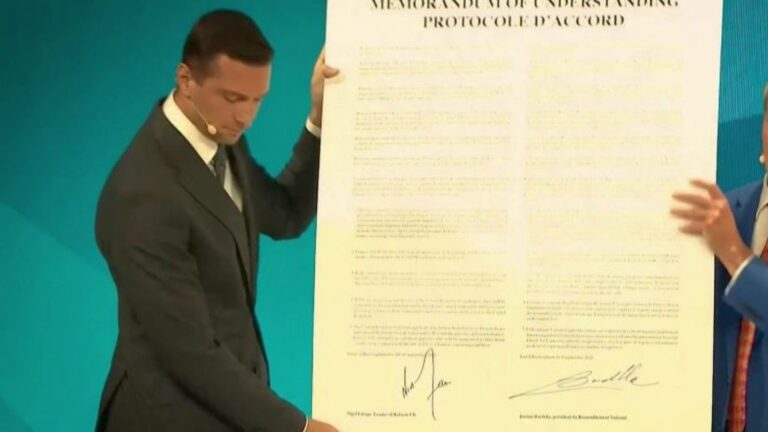
Professional interpreting helps participants understand international discussions accurately. A missing sentence, a misunderstood qualification, a commitment expressed differently: in an international discussion, a few words can change how an agreement is understood. The controversy surrounding the document signed by Jordan Bardella and Nigel Farage in September 2026 illustrates the importance of consistent language versions — and of professionals who can convey the precise meaning of an exchange.
For businesses, institutions and conference organizers, this story is a reminder that speaking a foreign language does not always provide everything needed to negotiate, understand and make an informed commitment.
Two language versions, a significant discrepancy
In its report on the agreement between Jordan Bardella and Nigel Farage, franceinfo identifies a difference between the French and English versions of the document concerning the return of migrants to France. A provision in the English version about France accepting them in principle does not appear in the French version described by the broadcaster. According to the report, National Rally cited readability and characterized the document as a declaration of intent to be refined.
The discrepancy prompted conflicting interpretations. In a report by The Guardian, Reform UK maintained that both parties had approved the agreement and shared the same position. These accounts do not establish that a signatory misunderstood the document or that an interpreter made an error.
They nevertheless raise an essential question: how can everyone involved be sure they understand the same thing in their respective languages?
Written translation and spoken interpreting: complementary expertise
This case primarily concerns a written document. Translating it and comparing its different language versions are matters for translation and revision.
An interpreter works during the exchanges themselves: a preparatory meeting, negotiation, press conference or discussion between delegations. Interpreting enables each participant to follow what others say and respond in their own language.
A professional interpreter does not replace the revision of a written agreement. A revised translation does not replace reliable interpreting during negotiations. Both services have a role in a high-stakes meeting.
A good interpreter conveys commitments, qualifications and nuances
In an international meeting, the challenge goes far beyond vocabulary. Interpreters must convey the degree of certainty, conditions and limitations expressed by each speaker.
For example, these statements do not mean the same thing:
- “We will consider this possibility.”
- “We accept this proposal in principle.”
- “We will implement this measure subject to certain conditions.”
An approximate rendering can suggest a firm commitment when the speaker expressed an intention or a qualification.
Professional interpreters must also remain impartial. Their role is to convey what is said, including sensitive or controversial statements. Accuracy, impartiality and confidentiality are among the principles highlighted by the International Association of Conference Interpreters — AIIC.
Quality interpreting starts before the meeting
A strong service requires preparation. The agenda, working documents, speakers’ names, specialist terminology and draft texts help interpreters understand the context and anticipate difficulties. AIIC emphasizes the importance of preparation materials and terminology work.
Organization matters too: intelligible sound, structured turn-taking and suitable equipment support an accurate rendering. Depending on the meeting format, simultaneous interpreting or consecutive interpreting enables participants to follow the discussion.
Before a multilingual document is approved, comparing its written versions is a separate step. It helps identify omissions, divergent wording and ambiguities that need clarification.
5 points to plan professional interpreting
When preparing a multilingual meeting, clarify these five points with your language service provider:
- Languages and directions. Specify the languages speakers will use and those participants need to hear. A French–English meeting may require interpreting in both directions.
- The format of the exchanges. Explain whether the event involves presentations, debate, negotiation or a site visit. The choice between simultaneous and consecutive interpreting depends in part on the meeting format and available time.
- Preparation materials. Share the agenda, available presentations and draft documents. Highlight specialist terms, acronyms and wording that needs particular attention.
- Technical conditions. Plan microphones, participants’ listening arrangements and sound checks. For remote meetings, also check connectivity and how speakers will take turns.
- Approval of the final document. Arrange a separate comparison of written language versions before approval. Professional interpreting facilitates discussion; it does not certify the documents resulting from it.
This preparation helps identify the skills and equipment the meeting needs. It also distinguishes the responsibilities of interpreters, translators and those approving the agreement.
A requirement that matters for businesses too
These issues extend well beyond politics. They arise in commercial negotiations, technical meetings, institutional exchanges and international conferences.
A misunderstood condition can lead to a disagreement over a deadline, price or allocation of responsibilities. Working with a professional interpreter helps reduce this risk and allows participants to focus on the substance of their discussions.
At Cultures Connection, we support organizations with their translation and interpreting needs. Planning a multilingual meeting? Explore our conference interpreting services and discuss the languages, subject matter and arrangements needed to help every participant understand and be understood.
Image: franceinfo / France 2 report on the Bardella–Farage agreement. Image source.